Friday, September 4, 2015

DRC's 'Terminator' tells ICC he protected civilians

Militia leader Bosco Ntaganda, accused of war crimes, tells court he was a professional soldier trying to restore peace.

A rebel leader known as "The Terminator" has told judges trying him at the International Criminal Court in The Hague that he was a professional soldier who never attacked civilians and tried to restore peace during a brutal conflict in eastern Congo.

Polling stations have closed after Burundi's controversial presidential election on Tuesday, which was marred by a widespread boycotts and the killing of at least two people — a policeman and a civilian, according to witnesses — in a string of explosions and gunfire in the capital, Bujumbura.

An opposition member was also killed overnight in the Nyakabiga neighborhood of Bujumbura, the center of three months of anti-government protests.

Their body was removed early Tuesday, several hours after the incident, which prompted a crowd to gather in protest before voting began. The protesters were boycotting the election and stayed at the scene, with riot police mobilized near them keeping a safe distance.

About 3.8 million Burundians are eligible to vote in the polls, but the country's opposition and many civil society groups are boycotting election, claiming they will not be free and fair. President Pierre Nkurunziza is widely expected to win an unprecedented third consecutive term, which the opposition have denounced as unconstitutional and a violation of the 2006 peace deal that ended a dozen years of civil war and ethnic massacres.

The nation's constitutional court has ruled in the president's favor, however, maintaining he is eligible for a third term because he was chosen by legislators — and not popularly elected — for his first term.

“Despite a facade of pluralism, this is an election with only one candidate, where Burundians already know the outcome,” said Thierry Vircoulon, an analyst with the International Crisis Group, which has warned the situation has all the ingredients for starting another civil war.

Ban Ki-moon, the United Nations secretary-general, has called on authorities to do all in their power to ensure security and a peaceful atmosphere during the election.

More than two months of anti-Nkurunziza protests, which have often been violently repressed, have left at least 100 dead since late April. Independent media have been shut down, and many opponents have fled, joining an exodus of more than 150,000 Burundians who fear their country may again be engulfed by widespread violence.

Doctors Without Borders said on Monday that about a thousand people were fleeing each day to Tanzania, crossing the border “through the forest ... many traveling in the dark on foot and without belongings.”

In mid-May, rebel generals attempted to overthrow Nkurunziza. After that bid failed, they launched a rebellion in the north of the country.

Last-ditch crisis talks mediated by Uganda broke down on Sunday.

“The government has opted to isolate itself and go ahead with pseudo-elections,” Leonce Ngendakumana, a prominent opposition figure, said after talks collapsed.

“They have refused to save Burundi from sliding into an abyss,” said Jean Minani, another opposition figure.

A poor and landlocked former Belgian colony, Burundi is in the heart of Central Africa's troubled Great Lakes region. Analysts say renewed conflict in the country could reignite ethnic Hutu-Tutsi violence and bring another humanitarian disaster on the region.

The conflict also risks drawing in neighboring states, as fighting in the neighboring Democratic Republic of Congo has.

The last civil war in Burundi left at least 300,000 dead.

Al Jazeera and wire services

Nigeria's President Muhammadu Buhari declares assets

Nigeria's President Muhammadu Buhari declares assets


http://www.bbc.com/news/world-africa-34150508 
  • 3 hours ago
  •  
  • From the sectionAfrica


Nigeria's leader Muhammadu Buhari has declared he has $150,000 (£100,000) in his personal account, in a move aimed at promoting transparency.
The amount showed the ex-military ruler and minister of petroleum had been living a "Spartan lifestyle", his spokesman Garba Shehu said.
The BBC's Will Ross says the assets are loose change for Nigerian politicians but a fortune for most of the country.
Mr Buhari is the first opposition candidate to win a national election.
The former military ruler was elected in March largely on a promise to tackle corruption and insecurity.
Corruption is a major problem in Africa's biggest economy and last month, Mr Buhari said that $150bn (£100bn) was missing from state coffers.

Buhari's assets:


President Muhammdu Buhari of NigeriaImage copyrightGetty Images
Image captionMr Buhari marks 100 days in office on Saturday

  • Five homes and two mud houses, as well as farms
  • An orchard and a ranch with 270 head of cattle,
  • 25 sheep, five horses and a variety of birds
  • Shares in three firms
  • Two undeveloped plots of lands
  • Bought two cars from his savings

Vice-President Yemi Osinbajo, a successful lawyer and pastor at one of Nigeria's biggest churches, is considerably wealthier.
Mr Shehu said in a statement Mr Osinbajo had $1.4m (£900,000) in his bank accounts.
In his declaration of assets, Mr Osinbajo also revealed that he owned a four-bedroom residence, a three-bedroom flat, a two-bedroom flat and a two-bedroom mortgaged property in Bedford, UK.


Nigeria Vice-President Yemi Osinbajo attend during the investiture ceremony for the new president of the African Development Bank (AfDB) Akinwumi Adesina, on September 1, 2015, in Abidjan.Image copyrightAFP
Image captionMr Osinbajo is a pastor at one of Nigeria's biggest churches

His political career started when he was appointed commissioner of justice in Lagos state in 2007 - a position he held for eight years.
The statement did not give the value of all the assets held by the president and the vice-president, saying the documents submitted to the Code of Conduct Bureau would be made public as soon as the verification process was completed.
The leaders are also required by law to declare their assets when they left office.
Late President Umaru Yar'Adua was the first Nigerian leader to declare his assets publicly.
He was reported to be worth $5m (£3.5m) when the declaration was made in 2007.

Analysis: Will Ross, BBC News, Lagos

We have long been told that Muhammadu Buhari prefers the austere life and now according to his spokesman there is evidence to back this up.
Muhammadu Buhari is no pauper. We are told he has less than $150,000 his bank account - a fortune for the vast majority of the population but probably the equivalent of loose change for many working in the dizzy world of Nigerian politics.
The law requires politicians to declare their assets to the Code of Conduct Bureau (CCB), which has a pair of handcuffs on its website but has been fairly toothless as the agency which has been "checking corrupt practices in the Nigerian public service since 1989".
The assets do not have to be declared in public but Gen Buhari's team clearly think shining a light on his "Spartan" lifestyle will help in the anti-corruption fight.
His predecessor Goodluck Jonathan was sharply criticized for refusing to go public even though his assets were declared to the CCB.
There may well now be some jittery politicians working out how they will look when compared to a president who has even declared his mud huts and livestock.
Nearly 1,000 people in Sierra Leone have been put under quarantine following the death of a 67-year-old woman who tested positive for Ebola.

It comes five days into a six-week countdown for the country to be officially declared Ebola-free.
The quarantine will last for three weeks, provided no new cases are recorded.

More than 11,000 people have died since the start of the Ebola outbreak in Sierra Leone, Guinea and Liberia.

BBC Africa Live: News updates

The BBC's Umaru Fofana in the capital, Freetown, says the authorities had been optimistic after a long period without any new Ebola cases and this caught them off-guard.

Our correspondent says the quarantine is stricter than previous ones. It includes a curfew in which people will not be allowed to move from one house to another.

Soldiers and police have been deployed to keep the quarantine in Sellakaffta, a village in Kambia on the northern border with Guinea.

The World Health Organization and Sierra Leone's health ministry are planning a vaccination programme for those who could have come into contact with the woman.

Guinea is still trying to contain its outbreak while the WHO announced that the Ebola virus had stopped spreading in Liberia for a second time on Thursday.

It had been declared free of Ebola transmission in May but then more cases were found the following month.


Wednesday, April 22, 2015

Kenya erects a wall along border with Somalia to keep out al-Shabaab (Telegraph) - Maleeha


Kenya is to build a 440-mile wall along its border with Somalia in a bid to keep outmilitants from al-Shabaab in a bid to boost security after a wave of attacks that have claimed scores of lives and brought severe criticism of the government’s response.
The wall, a series of concrete barriers, fences, ditches and observation posts overlooked by CCTV stations that is expected to stretch from the Indian Ocean to the city of Mandera where both countries converge with Ethiopia.
Like Israel’s “Separation Barrier” with West Bank, its stated aim is to keep out terrorists.

Nigeria protests to S. Africa over anti-immigrant attacks (Arab News) - Maleeha


Nigeria has complained to South Africa about a wave of attacks targeting foreigners and called on Pretoria to punish the culprits and compensate the victims, the Foreign Ministry said on Wednesday.
Junior Foreign Minister Musiliu Obanikoro summoned South Africa’s High Commissioner Lulu Mnguni “to register Nigeria’s protest over the ongoing xenophobic attacks against fellow Africans in South Africa”.
“In the meeting, ambassador Obanikoro condemned the attacks on foreigners in South Africa, expressing concern on the fate of Nigerians and indeed of other nationals who are migrants in the country,” said a statement from his office.

Boko Haram crisis: Nigeria begins Sambisa ground offensive (BBC) - Maleeha


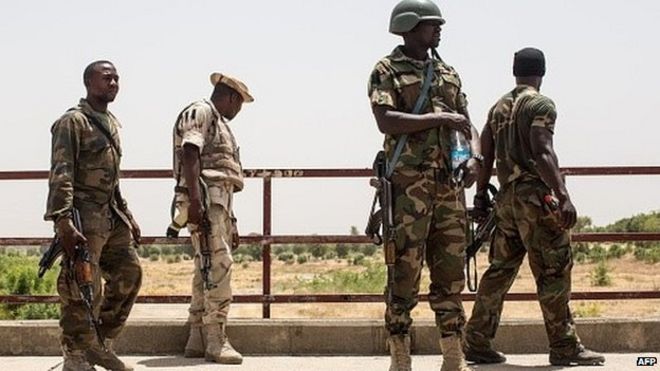
Nigerian ground troops have joined an offensive on the last known hideout of the Boko Haram Islamist militants, a military spokesman has told the BBC.
The vast north-eastern Sambisa forest is where they have many bases - and it has been subject to aerial bombardments since February.
There has been speculation that some of the Chibok schoolgirls kidnapped more than a year ago are being held there.
Boko Haram has killed thousands in northern Nigeria since 2009.
Nigeria's military, backed by troops from neighbouring countries, launched an offensive against Boko Haram in February - and has recaptured most of the territory the militants had taken in the previous year.